


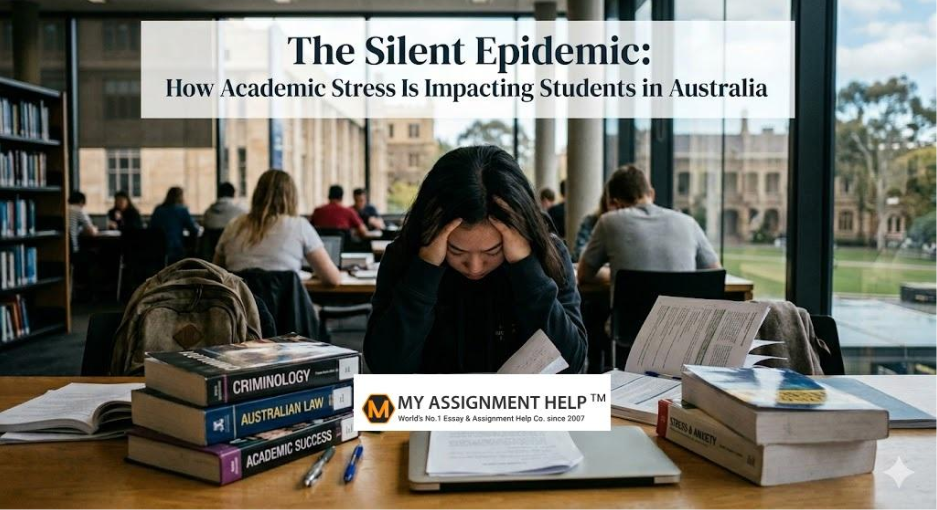
In the high-pressure corridors of Australian secondary schools and prestigious institutions like the University of Melbourne, ANU, or the University of Queensland, a silent crisis is unfolding. While Australia’s education system is consistently ranked among the best in the world, the mental health toll on its participants is reaching a breaking point. From the frantic preparation for the HSC and VCE to the grueling demands of postgraduate research, academic stress has become a defining characteristic of the Australian student experience.
Key Takeaways: Managing the Pressure
- Identify the Source: Understand if your stress is coming from the ATAR, financial pressure, or “imposter syndrome.”
- Micro-Goal Setting: Break 3,000-word assignments into manageable 200-word chunks.
- Utilize “Fair Go” Policies: Reach out for extensions or special consideration early.
- Diversify Support: Combine university counseling with professional academic assistance to manage heavy workloads.
- Physical Boundaries: Keep study zones and rest zones separate to maintain sleep hygiene.
The State of Play: Why Australian Students are Feeling the Burn
Academic stress isn’t just about having “too much homework.” It is a complex psychological distress resulting from the perceived pressure to succeed, the fear of failure, and the exhaustion of maintaining a competitive edge. In Australia, several unique factors contribute to this phenomenon, creating a “perfect storm” for student burnout.
1. The Cost of Living and Student Debt
University students in Australia aren’t just focused on lectures and assignments—they’re also dealing with real financial pressure. With rent climbing steadily in major cities like Sydney, Melbourne, and Brisbane, many students take on 20 or more hours of part-time work each week, often in retail or hospitality, while still managing full-time study. Juggling shifts, deadlines, and academic expectations can quickly become overwhelming. As a result, students who struggle to keep everything on track often turn to reliable assignment help Brisbane to maintain consistent grades while handling their financial responsibilities.
The looming shadow of HECS-HELP debt adds a layer of long-term financial anxiety. As indexation rates fluctuate, students see their future debt grow before they have even entered the professional workforce. This financial pressure often forces a “survival mode” mentality, where academic performance suffers because the student is simply too exhausted from balancing work and study.
2. The ATAR and State Certificate Obsession
For high school students in Years 11 and 12, the ranking systems—whether it’s the HSC in New South Wales, the VCE in Victoria, the QCE in Queensland, or the SACE in South Australia—are often portrayed as the “be-all and end-all.” The Australian Tertiary Admission Rank (ATAR), while designed to streamline university entries, creates a hyper-competitive environment where students are effectively pitted against their peers.
This “rank culture” fosters a sense of inadequacy for those who do not fall into the top percentiles. It ignores the diverse talents of students who may excel in creative arts, vocational skills, or practical trades, placing an inordinate amount of value on a single numerical score.
3. The “International Student” Pressure
Australia remains a global hub for international education. These students face unique, compounded stressors:
- Financial Stakes: The pressure to justify the massive tuition investment made by their families.
- Language Barriers: Navigating high-level academic English in a second or third language.
- Visa Uncertainty: The constant stress of maintaining grades to secure post-graduate visa pathways and future residency.
Faced with these high stakes, it is increasingly common for students to hire someone to do my homework to ensure their technical submissions meet rigorous Australian standards.
The Ripple Effect: How Stress Manifests
Academic stress does not stay confined to the library; it leaks into every aspect of a student’s life, manifesting in ways that can have long-term consequences.
Physiological Impacts
When the brain perceives a threat—like a looming final exam—it triggers the “fight or flight” response, releasing cortisol and adrenaline. While useful for short-term tasks, chronic activation of this system leads to:
- Sleep Deprivation: A common sight in Australian “24-hour” university libraries, leading to cognitive decline.
- Digestive Issues: Stress-induced IBS and the “instant noodle” diet often adopted by time-poor students.
- Weakened Immune System: Making students more susceptible to seasonal flus, which then leads to further academic backlog.
Psychological and Emotional Impacts
The mental health statistics among Australian youth are sobering. Academic stress is a leading contributor to:
- Anxiety and Depression: Constant worry about grades can evolve into clinical anxiety, where the student feels a sense of dread even when not studying.
- Burnout: A state of emotional, physical, and mental exhaustion. In an Australian context, this often leads to students “dropping out” or taking unplanned gap years just to recover.
- Imposter Syndrome: The persistent inability to believe that one’s success is deserved, leading to a fear of being “found out” as a fraud during tutorials or seminars.
The Role of Support Systems
Recognizing that students cannot carry this burden alone, the focus must shift toward robust, multi-layered support systems.
Institutional Responsibility
Universities across the country are beginning to implement better mental health frameworks. However, there is often a gap between “having a policy” and “providing accessible care.” Wait times for campus counseling services can often stretch into weeks during peak exam periods, leaving students in crisis without immediate help. There is a dire need for universities to move beyond “RU OK? Day” events and into year-round, proactive mental health support.
The Rise of Academic Assistance
As the curriculum becomes more demanding and the shift toward “skills-first” learning accelerates, many students are turning to external resources to manage their workloads. Whether it’s specialized tutoring, peer study groups, or dedicated online platforms, seeking help is becoming a normalized part of the academic journey.
For those struggling to balance work-life commitments, professional guidance from Myassignmenthelp.services can provide the structural support needed to manage complex projects. This type of academic assistance allows students to focus on deep learning while receiving the organizational help required to prevent complete burnout.
Actionable Strategies for Managing Academic Stress
If you are a student currently feeling the weight of the Australian curriculum, here are actionable strategies to regain control:
- Redefine Success Beyond the Rank: Your ATAR, GPA, or WAM is a measurement of a specific set of skills at a specific point in time. It is not a measurement of your worth. Australia has numerous “pathway” programs; if you don’t get the marks for your dream course immediately, there are TAFE-to-Uni pathways and internal transfers that offer a second chance.
- Practice “Productive Procrastination”: Total avoidance of work increases anxiety. Instead, break tasks into “micro-goals.” Instead of saying “I need to write a 3,000-word essay,” tell yourself “I will write the first three sentences of the introduction today.” Small wins build momentum.
- Establish Physical Boundaries: With the rise of hybrid and online learning, the bedroom has become the classroom. This blurs the lines between rest and work. Try to keep your study space separate from your relaxation space to help your brain “switch off” at night.
- Leverage the “Fair Go” Spirit: Don’t be afraid to ask for help. Australian educators are increasingly aware of the mental health crisis. If you have a legitimate struggle—whether it’s a family emergency or a mental health “flare-up”—reach out to your unit coordinator or school counselor early. Most institutions offer “Special Consideration” for exactly these reasons.
- Utilize SEO-Driven Productivity: Use tools like the Pomodoro Technique or Eisenhower Matrix to prioritize tasks that have the highest “E-E-A-T” (Experience, Expertise, Authoritativeness, and Trustworthiness) value for your specific degree.
The Future of Education in Australia: A Necessary Cultural Shift
To truly address academic stress, Australia needs a cultural shift. We must move away from a model that treats students like data points in a ranking system and toward a model that prioritizes holistic well-being. This involves:
- Reducing the weight of “high-stakes” end-of-year exams in favor of continuous, project-based assessment.
- Integrating mental health literacy into the national curriculum from as early as Year 7.
- Increasing funding for accessible, immediate mental health support on campuses to reduce wait times.
- Embracing Digital Literacy: Teaching students how to use AI and academic tools ethically as “co-pilots” rather than viewing them as threats to academic integrity.
Conclusion
Academic stress is an inevitable part of the pursuit of excellence, but it should never be debilitating. For students in Australia, the pressure is real, but so is the support available. By fostering open conversations about mental health and utilizing resources—be it university counseling, peer support, or professional academic assistance from Myassignmenthelp.services —students can navigate the challenges of high school and university without sacrificing their well-being.
Remember, your health is your greatest asset. No grade, no matter how high the ATAR, is worth the price of your peace of mind. As you head into your next exam season, prioritize your rest as much as your revision.
Frequently Asked Questions
Q.1 How does the ATAR actually affect my future career?
While the ATAR is the primary tool for university entrance in Australia, its long-term impact is often overstated to high school students. Many professionals in high-paying Australian industries entered their degrees through alternative pathways, such as diplomas, internal university transfers, or mature-age entry. Once you have completed your first year of university or entered the workforce, your ATAR becomes largely irrelevant to employers.
Q.2 What are the first signs of academic burnout?
Burnout doesn’t happen overnight. Early warning signs include a persistent lack of motivation, “brain fog” during lectures, increased irritability with peers, and physical symptoms like tension headaches or changes in appetite. If you find that you are studying for hours but retaining zero information, you are likely experiencing the early stages of burnout.
Q.3 Is it “cheating” to use academic assistance services?
Seeking help is a sign of academic maturity, not a lack of integrity. Using services for tutoring, proofreading, or structural guidance—like those provided by Myassignmenthelp.services —is about learning how to manage complex projects and understanding difficult rubrics. As long as the final submission is your own work and you follow your institution’s specific academic integrity guidelines, external support is a legitimate tool for learning.
Q.4 How can international students manage the pressure of high tuition fees?
International students should prioritize “financial literacy” alongside their studies. This includes understanding their work rights under Australian student visas (currently capped at 48 hours per fortnight during semesters) and seeking out “equity grants” or bursaries offered by most Australian universities. Additionally, using time-management frameworks like the Pomodoro Technique can help maximize study efficiency, leaving more time for part-time work without sacrificing grades.
Q.5 What should I do if I miss an assignment deadline due to stress?
The first step is communication. Australian universities have “Special Consideration” policies for students experiencing significant mental health distress. You should obtain a medical certificate or a counselor’s letter and contact your unit coordinator immediately. Educators generally prefer a student who reaches out for a “Fair Go” rather than one who simply disappears.
About the Author Drake Miller
I am a skilled blog author associated with Myassignmenthelp.services. He specializes in crafting insightful, student-focused content on academic writing, time management, and study strategies. His articles are designed to simplify complex concepts and support learners worldwide. Through clear, engaging writing, he helps students improve their academic performance and confidence in their studies, consistently delivering practical guidance for success online.
